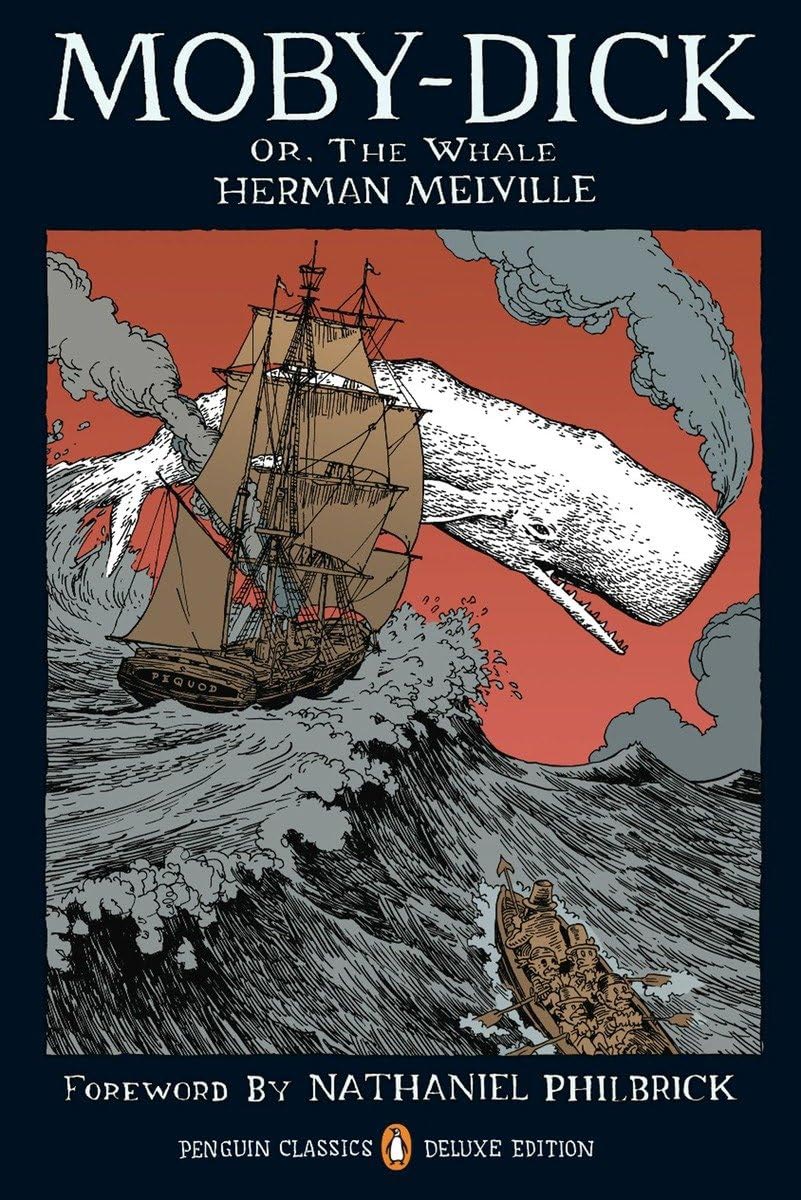

Few novels in American history have traveled a path as strange and dramatic as Moby-Dick. Published in 1851 by Herman Melville, the book was initially met with confusion, mixed reviews, and poor sales. Nearly two centuries later, it stands as one of the most studied, debated, and celebrated works in world literature—a novel that continues to generate new interpretations, adaptations, and readers.
In recent years, Moby-Dick has experienced a renewed surge of interest. University courses continue to center it as a foundational American text, while new editions, audiobooks, stage adaptations, and critical essays have brought Melville’s whaling epic to audiences far beyond traditional literary circles. What was once considered an overlong and unruly failure is now widely regarded as a masterpiece.
At its surface, Moby-Dick tells a relatively simple story. Ishmael, a restless sailor, joins the whaling ship Pequod under the command of Captain Ahab, a man obsessed with hunting the white whale that previously destroyed his leg. What follows is a voyage across the world’s oceans, culminating in tragedy as Ahab’s fixation leads the ship and its crew toward destruction.
Yet the novel’s endurance lies in how quickly it escapes that simple summary. Melville’s book blends adventure narrative, philosophical treatise, scientific catalog, religious meditation, and dark comedy. Chapters shift abruptly from thrilling action to detailed explanations of whale anatomy, from Shakespearean soliloquies to scenes of everyday labor aboard a ship. For modern readers, this formal unpredictability can feel surprisingly contemporary.
“Moby-Dick refuses to behave like a novel,” said Dr. Elaine Foster, a professor of American literature at Columbia University. “It challenges the reader at every level—structurally, intellectually, morally. That resistance is precisely why it has lasted.”
The novel’s reputation did not solidify until long after Melville’s death. During his lifetime, Melville saw his popularity fade, and Moby-Dick was largely forgotten by the end of the 19th century. It was not until the early 20th century, during a period now known as the “Melville Revival,” that critics and scholars began to reassess the book’s ambition and complexity.
This reassessment transformed Moby-Dick from a commercial disappointment into a cornerstone of American literature. Writers such as William Faulkner and D.H. Lawrence praised its scope and symbolic depth, while critics began to see Captain Ahab as one of fiction’s great tragic figures—a man whose quest for meaning curdles into self-destruction.
Today, Ahab’s obsession is often read through modern lenses. Some view him as a symbol of humanity’s destructive relationship with nature, others as a portrait of unchecked authority or monomania. In an era shaped by environmental crisis and political polarization, the novel’s themes feel newly urgent.
“There’s something deeply contemporary about Ahab,” said Foster. “He’s consumed by a single idea, incapable of compromise, and willing to sacrifice everything for it. That resonates in ways Melville couldn’t have predicted.”
At the same time, Moby-Dick is also celebrated for its moments of warmth and humanity. Ishmael’s curiosity, humor, and openness provide a counterbalance to Ahab’s severity. The novel’s early chapters, particularly Ishmael’s friendship with the harpooner Queequeg, have been widely praised for their tenderness and progressive portrayal of cross-cultural connection.
That relationship, along with the novel’s diverse multinational crew, has attracted renewed scholarly attention. Critics note that Melville presents the Pequod as a floating microcosm of the world—one in which people of different races, religions, and backgrounds work together, even as they are bound to a captain who ultimately leads them to ruin.
Beyond academia, Moby-Dick continues to permeate popular culture. References appear in films, television, music, and even business writing, where the “white whale” has become shorthand for an all-consuming pursuit. New adaptations regularly reinterpret the story, from graphic novels to experimental theater productions.
Yet for all its influence, the novel remains challenging. Its length, digressions, and dense language intimidate many first-time readers. Educators and publishers have responded by offering annotated editions, reading guides, and modernized audiobooks aimed at making the text more accessible without simplifying its content.
“There’s a misconception that Moby-Dick is a book you endure,” said Foster. “But it’s often funny, playful, and strange. Once readers give themselves permission not to understand everything, the book opens up.”
That sense of discovery may explain why Moby-Dick continues to attract new readers despite its age. Unlike many classics, it does not present a neatly resolved moral or a clear worldview. Instead, it asks questions—about fate, knowledge, power, and obsession—that resist easy answers.
In an age dominated by fast-paced media and algorithm-driven content, Melville’s sprawling, defiant novel stands apart. It demands time, patience, and engagement, offering no shortcuts and no guarantees. For some readers, that demand is precisely its appeal.
As Moby-Dick approaches its 175th anniversary, its place in the literary canon appears secure—not as a relic, but as a living text, constantly reinterpreted and reargued. What began as a misunderstood whaling novel has become a mirror in which each generation sees its own fears, ambitions, and obsessions reflected.
In that sense, the white whale still swims on—elusive, provocative, and impossible to fully capture.